All guides Plate IV All levels

Tarantulas

Theraphosidae

Although they have an undeservedly bad reputation thanks to modern media and film, tarantulas are by far the most common residents of the terrarium hobby. With their interesting looks and behaviour, and very modest care needs, they are very often the first choice of beginner keepers. Because of their diversity (around 900 species), keepers who start with one or two tarantulas often become true collectors over time, sometimes with hundreds of unusual and rare species of these eight-legged arthropods.

Tarantulas (Theraphosidae)

Quick facts

Species
around 900
Size
2–30 cm
Lifespan
females 25+ years · males 2–7
Activity
evening and night
Enclosure
from 30×30 cm for adults
Temperature
22–30 °C
01

Appearance

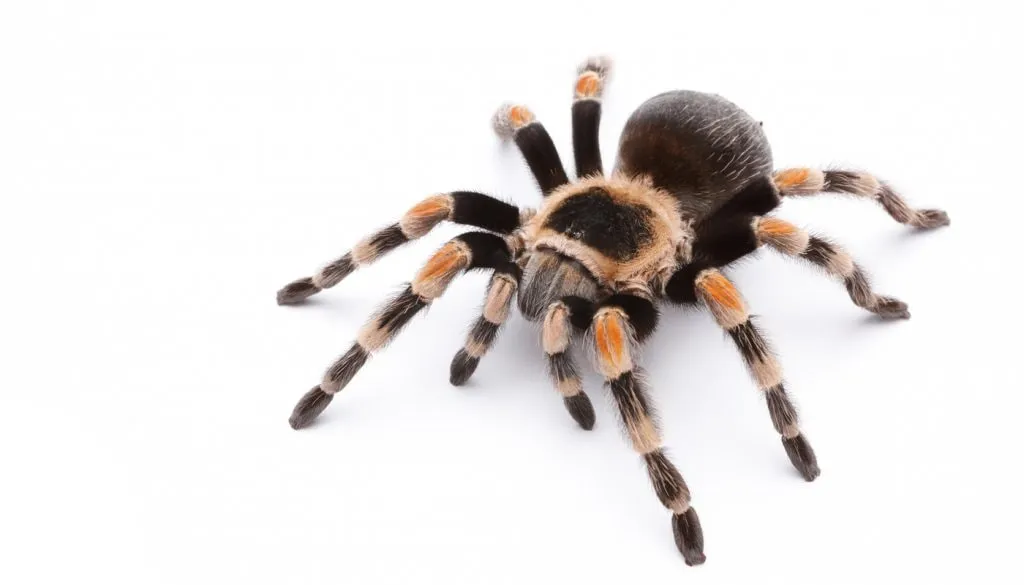
Tarantulas vary in size, from small ones reaching barely 2 cm up to the 30 cm of the largest tarantula, T. blondi, which at over 170 g is also among the heaviest. Common to all tarantula species is a two-part segmented body covered in dense hairs, with 4 pairs of strong legs and a pair of “arms” (pedipalps) used for handling food, digging and so on. Another important difference are the chelicerae, a pair of parallel appendages housing the venom glands, with fangs that have limited mobility (only along the vertical axis) compared to true spiders. The chelicerae are located at the front of the carapace, just below the 4 pairs of eyes.

At the rear, on the abdomen (opisthosoma), are the spinnerets, appendages for producing silk, which tarantulas spread over the ground and around their burrow. Although the web plays no direct role in catching prey, it transmits vibrations that the tarantula picks up with numerous sensory hairs, unerringly locating the position of the prey.

02

Choosing and buying

The most important thing when buying a tarantula is to provide adequate living space before you get it, since otherwise it is not unusual for it to die within a few days. It is also important to read up on the species from several sources, because different species can have different needs regarding enclosure, temperature, humidity etc. If buying a young tarantula, it is better to take a female (although sexed tarantulas cost more), because they can live over 25 years and are usually more colourful and larger. Males live 2–7 years, i.e. 5–7 months after their final moult.

The abdomen should be regularly shaped, in proportion with the body — a shrivelled, wrinkled abdomen is a sign of dehydration. Also check that the tarantula has all its limbs. Although limbs can regenerate after 1 to 3 moults, missing limbs and dehydration can be a sign of poor conditions and neglect.

03

Behaviour

For movement and bodily function, tarantulas rely on a hard chitinous shell — the exoskeleton. To grow, they moult: they shed the old “shell”, beneath which the next, larger exoskeleton has already formed and which hardens over a few days. During this period, roughly a week before and after the moult, the tarantula moves less and does not take food. When this behaviour is noticed, they should not be disturbed, especially after the moult, while the exoskeleton is still soft and unformed. Being active in the evening and at night, they spend most of the day resting in the open, in a burrow or in tunnels among branches, depending on the species. They hunt by relying on vibrations carried by the silk strands spread around their home. When catching prey, the bite injects a paralysing venom and enzymes that break down internal tissues, so it can be said that digestion in tarantulas begins before they eat the prey.

Although there are calm-natured species that can be handled, native to North and South America — the New World tarantulas — there is always a chance that a wrong move will make the tarantula feel threatened and bite. Since their venom itself is no stronger than a bee’s or a wasp’s, it is far more likely that in a panic the tarantula will be dropped or thrown to the ground, which can cause loss of limbs, a ruptured exoskeleton and/or death. As a further defence they use irritating hairs, which they flick into the air with quick movements of the hind legs. If these land on skin, mucous membranes or eyes, they can cause severe irritation with rash and redness.

On the other hand, Old World tarantulas, native to Asia, Africa and Australia, although they lack irritating hairs, are considered more nervous, more aggressive and far more ready to attack. Their venom is considerably more potent than that of their American relatives, so a bite can cause symptoms such as intense pain, swelling, fatigue, difficulty breathing, nausea and muscle cramps, though hospitalisation is rarely needed. For all the above reasons, the conclusion is that tarantulas are animals to be enjoyed from a distance, so if you want an animal you can interact with often, it is best to skip this kind of pet.

04

Sexing

Sexing tarantulas can be relatively complicated without prior experience. In young tarantulas, males and females look almost identical while growing up, so the only reliable way to determine sex is to examine a freshly shed skin from the inside, in the abdominal area, with a magnifying glass or microscope. Between the upper pair of book lungs, just below the junction of the abdomen and cephalothorax, females have a spermatheca in the form of an ellipsoid bulge. In sexually mature animals, on the other hand, males are relatively easy to recognise by the hooks they develop on the first pair of legs and the so-called bulbs that appear at the tips of the pedipalps as shiny spheres, used to transfer sperm to the female’s spermatheca.

05

Enclosure and conditions

By habitat, tarantulas fall into 3 groups: arboreal — living in tall grass and shrubby vegetation, above the ground; terrestrial — oriented to the ground surface, though most of these species will burrow if given the chance (they use abandoned burrows, tree roots etc. as shelter); burrowers — digging deep tunnels underground and coming to the surface only in search of food.

The enclosure should match the tarantula’s size, to reduce potential stress and make catching prey easier. Young tarantulas of 5–10 mm can easily be kept in a PVC film canister or similar, moving to a bigger container every few moults. For adults, an enclosure with a 30×30 cm footprint is enough for most species; for terrestrial and burrowing tarantulas the height can be 30 cm, while for arboreals it should be vertical, around 40+ cm tall (the footprint can then be narrower, e.g. 30×20 cm). Ventilation should take up half the lid or part of the sides, and the mesh must be metal, since a tarantula may chew through plastic mosquito netting. A very important role of ventilation is preventing mould, which can kill a tarantula, so for optimal air circulation the vents should be placed on opposite sides of the enclosure.

The substrate plays an important role in regulating humidity and providing hiding places. Coco peat is best, though potting soil will do if you are sure no chemicals have been added. Arboreal and terrestrial tarantulas need a 5–7 cm layer of substrate, while for burrowers the substrate must fill 2/3 of the enclosure. Logs, branches for arboreals, bark (not from conifers), rocks, (artificial) plants etc. can be used as décor. It is important to sterilise everything that goes into the enclosure with boiling water or in the oven. Live plants bought from florists may have been sprayed with insecticide or other chemicals, so rinse them thoroughly before putting them in. Tarantulas do not need light — it even bothers them — but dark-coloured bulbs are recommended for heating. Since they come from the tropics, the temperature should range between 22 and 30 °C, while humidity is effectively regulated by regularly moistening one part of the substrate.

Tarantula genera found in the hobby (within each genus there are many species with similar or identical care requirements) — New World tarantulas (North and South America): arboreal Avicularia, Psalmopoeus, Iridopelma; terrestrial Acanthoscurria, Grammostola, Brachypelma; burrowers Ephebopus. Old World tarantulas (Asia, Africa and Australia): arboreal Poecilotheria, Lampropelma; terrestrial Pterinochilus, Selenocosmia, Hysterocrates; burrowers Citharischius, Haplopelma.
06

Food and water

Tarantulas are strict carnivores and not overly picky. As long as the insect is not larger than their leg span they will overpower it — though it is always better to offer prey of moderate size. In captivity they are most often fed crickets, superworms, mealworms, dubia, Turkistan roaches etc. Very occasionally a pinky (baby mouse) can be offered, though these are best avoided because of potential problems with the chelicerae. An important point is to add only as many insects as the tarantula can eat, because leftover live insects cause stress and, if not removed, can injure a resting tarantula or in the worst case cause its death. Water is provided simply, with a shallow dish or bottle cap in one part of the enclosure. It can also be provided by regularly misting the enclosure, but a dish is the more practical option in any case.

See our feeder insects for this species

The advice given in this text is the result of many years of experience combined with literature and should not be taken as the definitive and only way of keeping the species. To get a fuller picture and give your pet a long and healthy life, we advise you to consult several sources. If you have any further questions, you can contact us by e-mail: petreptilez@yahoo.com

Interested?

Contact us for more information about this pet, availability and care advice.